One of the mysteries many new bloggers face is how to do keyword research for blogs. As a blog coach, I see the frustration with understanding how to do research keywords for SEO in my blogging Facebook group members and clients alike.
As a professional SEO digital copywriter and blog coach, I’m sharing insights to make it easier for you to understand how to find keywords for blog posts, so you can start ranking in search results.
My goal in this guide on keyword research for beginners is to get you up to speed, fast.
We’re going to break it down, so you can start doing keyword research like a pro. You can’t escape doing Search Engine Optimization (SEO) for blogs, so you may as well embrace it!
Search engines may be changing with the arrival of AI tools like ChatGPT, and new features such as Google’s Search Generative Experience (AI Overviews and more). However, SEO is crucial to long-term blogging success.
Basic keyword research is a foundational blogging skill that you can adapt to work more than just on-page SEO. The good news is that you don’t need to be a marketing pro to learn it.
Let’s jump in: read this full guide to keyword research for bloggers and get started updating your blog posts for SEO today!

DISCLOSURE: This post contains affiliate links, meaning if you click on a product or service, and decide to purchase it, I may receive a commission at no extra cost to you. All recommended products and services are based on my positive experience with them. For more information, please read my Disclaimer.
Bookmark this post on keyword research for SEO for future reference – pin it to Pinterest!

My Approach To Keyword Research
Every SEO expert and blogger has their own approach to keyword research.
Here’s how I do my keyword research for SEO:
- Review my existing blog posts: do I have a topic cluster that’s missing a blog post on a sub-topic?
- Review my readers’ problems and questions to understand what they’re searching for online
- Develop a blog post idea based on my readers’ needs
- Find a core keyword that aligns with my readers’ search intent
- Start brainstorming potential long-tail keywords they may use
- Review the core keyword and longtail keywords in the Google autocomplete: are people searching for them?
- Using a keyword tool (Keysearch.co is excellent), I write down longtail keywords that might work
- I fine-tune my focus keyword and longtail keywords by checking for volume and competition
Now I’m ready to write! We’ll go into details into the specific steps, so you’re doing keyword research for SEO like a pro.
Why Is Keyword Research Important?
Keyword research for SEO is essential for bloggers because it helps you create discoverable content that your audience is actually searching.
When you start a blog, you may start writing blog content without thinking about how it will be discovered or whether it’s of interest to readers.
Instead of guessing what to write, you’re making strategic choices that boost your chances of being found on Google and Pinterest.
When you know how to do keyword research for SEO, you know how to grow traffic, attract the right readers, and build authority.
You do this without wasting time writing posts that get ignored.
Think of it as your content compass, pointing you in the right direction every time.
Here are common SEO mistakes bloggers make:
- Not starting with SEO soon enough. Many start writing blog posts without optimizing them with keywords.
- Ignoring what their target audience is looking for online. What kind of questions are they seeking answers to?
- Not using the right keywords and longtail keywords for blog topics makes it hard to gain visibility online.
- Choosing keywords that are too difficult to rank for.
By the end of this blog post, you’ll have the insights and knowledge so you don’t make these SEO mistakes. Your blog writing will be stronger and better for online discovery in search engine results.

Why Is Keyword Research Worth Your Time?
When you do keyword research before writing a blog post, you’re:
- Creating content that your readers are actually searching for
- Choosing a focus keyword that aligns with what people are Googling
- Increasing your chances of showing up on search engines
- Growing your blog traffic (and blog monetization potential)
- Saving time by planning smart, purposeful content
PRO TIP: Don’t just stop at one keyword. Search for a primary keyword and secondary keywords that you can sprinkle throughout your blog content. This improves your chances of getting discovered online for similar words that people may be using, aside from the main SEO keyword.
What Is Keyword Research?
Keyword research is the process of finding the right phrases your ideal readers are using in Google and other search engines to find content on a specific topic.
Your readers are often seeking inspiration, ideas, guides and answers.
When you use the right blend of keywords and phrases in your blog content, Google and other search engines understand what your post is about. This makes it easier for them to index your content and rank it for discoverability online.
Keywords are the connector between the reader and you. Search engines are the platform that helps facilitate discovery.
Ever since I started using keyword research for writing blog posts, my organic search traffic has skyrocketed for all of my blogs. It’s a number one blogging skill I share with my blog coaching clients.
What Are The Best Keyword Research Tools For Bloggers?
When you’re beginning your blogging journey, you’re looking for budget-friendly, inexpensive and free keyword research tools.
Here are my favourite, best keyword search tools for beginner bloggers:
- Keysearch.co – An affordable keyword research tool that’s easy to use. It’s also got a handy tool for writing AI-optimized outlines to better structure your blog content.
- Google Autocomplete: It’s free, and shows what people are actively searching for online.
- Google Keyword Planner: You can access it with a Google Ads account. It helps you find search volume and keyword ideas.
- Keyword Surfer: A free Chrome extension that shows you the volume of searches for any given keyword.
- Keywords Everywhere: Another Chrome/Firefox/Edge extension with free features that show search volumes. The paid version provides you with powerful insights into competitors so you can craft content to rank better.
- LowFruits.io – A reasonable monthly subscription helps you find low-competition keywords that are easy to rank for online.
- Google Trends – For finding seasonal content trends, so you’re writing a blend of evergreen and timely content.
- AlsoAsked.com – Free with limited access, it expands on the “People also asked” feature in Google results.
I’ve tested and used these throughout the years to find the best keywords for my blog content.
While Semrush and Ahrefs are robust SEO keyword tools, they are unfortunately pricey.
At some point, you will need to invest in blog tools and resources that help you scale up content creation and promotion.
PRO TIP: You may want to look into RankIQ – a great tool for beginner bloggers. It’s a useful research tool that’s curated with keywords that help you rank faster. In a way, it’s similar to LowFruits.io. Check out both to see which works best for you!
| RELATED: 15 Best Free Blogging Tools For Beginners

Keyword Research Glossary For Beginners
There are many SEO-related terms you’ll come across, and they will overwhelm you at first. This is why I’ve pulled together this keyword research glossary for beginners, so you can break through the jargon.
Here’s a quick cheat sheet for those terms:
SERP (Search Engine Results Page) – The list of websites that appear after you search for something on Google.
Keyword – A word or phrase people type into a search engine. These guide what you write about.
Focus Keyword – The main keyword you want your blog post to rank for. It’s your central topic.
Short-Tail Keyword – A shorter, broader keyword with a higher search volume. They are hard to rank for when you’re a beginner blogger.
Long-Tail Keyword – A longer, more specific search phrase like “easy weeknight dinners for picky kids.” Lower competition, more targeted.
Search Intent (also called Keyword Intent) – The why behind the search. Are they looking to buy, learn, compare, or find something?
Branded Keywords – Keywords for a specific brand name. For example, a keyword could be your blog name (which is a brand).
SEO (Search Engine Optimization) – Strategies to help your content rank higher in search engines like Google.
Search Volume – The average number of people searching for a keyword each month. More isn’t always better. Sometimes zero-volume keywords can be a goldmine of traffic.
Keyword Difficulty (or SEO Difficulty – often short form KD, SD) – A score that shows how hard it would be to rank for a keyword. Lower is easier.
Keyword Cannibalization – When multiple posts on your blog target the same keyword, they compete with each other.
LSI Keywords (Latent Semantic Indexing) – Fancy way of saying: related keywords. These help Google better understand your topic.
Seed Keyword – A simple, broad term you start with (e.g. “blogging tips”). You build ideas off this one.
Benchmark Keyword – A keyword you already rank for, used to compare others in tools like Google Trends.
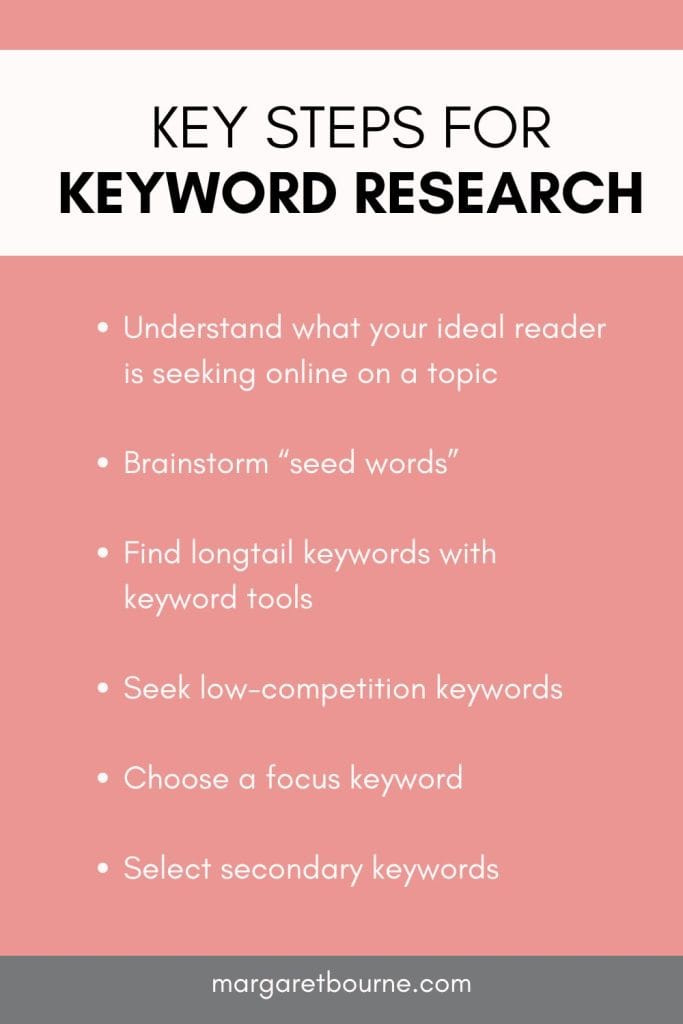
How To Do Keyword Research For Blogs: Step-by-Step
Here’s how to do keyword research in a way that works easily for new bloggers, even if SEO feels completely overwhelming.
1. Know Your Audience: Understand Who You’re Writing For
Understand your target audience – your ideal blog reader. What are they struggling with? What are they Googling, pinning to their vision boards or dreaming about?
When you get into their mindset, it’s easier to choose the right keywords.
What Is Search Intent In SEO?
Search intent (also called “user intent”) is the reason behind the person’s online search – the “why”. It’s what they are trying to find out when they enter the keywords into the search bar.
Search intent is categorized in three ways:
- Informational: Using keywords in searches to learn about a subject. An example is “how to start a blog”.
- Transactional: A search when you’re ready to buy. For example, “best WordPress themes for lifestyle bloggers”.
- Comparative or Commercial Intent: You’re researching before buying. For example, “WordPress vs Wix”
Understanding search intent with keywords is important for bloggers.
If you’re using keywords in your blog post that don’t align with your readers’ intent, you risk your blog post not ranking.
This is why it’s important to ask yourself: “What is the person really looking for and how can I clearly create content that answers their need?”
Match your content to your readers’ needs and watch them turn into loyal fans!
PRO TIP: Always do some research before starting to write on a topic. Find out if the keywords are growing in popularity or not. The best free tool for this is Google Trends. For example, Marie Kondo-style decluttering tips were hot a few years ago. While decluttering is still a popular topic, other topical keywords are now popular.
2. Brainstorm “Seed Words”
Now that you have the topic and search intent, your next step in SEO keyword research is coming up with a list of seed words.
What are these types of keywords? Seed words are basic ideas or phrases. They’re usually short. Here are a few examples:
- capsule wardrobe
- start a blog
- seo research
When you type them into your search engine’s browser, you see what autocomplete provides for you. This gives you insights into what people are searching for under that general seed word.
Write down these results. They are real data that can turn into excellent blog posts.
PRO TIP: Use Google’s People Also Ask and Related Searches sections to find more topics for these seed words.
3. Find Longtail Keywords With Keyword Tools
Those short seed keywords are very hard to rank for, as they are popular, high-competition keywords.
Your next step is to find long-tail keywords – usually about 3 to 5 words long-that are easier to rank for in search results.
To find these keywords, you’ll need to use keyword tools. My favourite keyword search tools are Keywords Everywhere or Keysearch.co.
Plug the seed keywords in and look for:
- Search volume: how many people search for it monthly
- SEO difficulty: how hard it is to rank
- Long-tail keywords: longer, more specific phrases with lower competition
What do long-tail keywords look like? Instead of targeting “start a blog,” go for “start a blog for beginners.” The longtail keyword is what will get your blog traffic and engagement.
Wondering – How many keywords should I use for SEO? One main keyword and usually about 3 to 5 additional keywords.
Use a helpful SEO plugin like RankMath to help you determine how many times to use these keywords throughout your post.
4. Seek Low Competition Keywords
A common mistake new bloggers make is to choose keywords that big sites like Forbes or Real Simple rank for in search results.
When you are doing keyword research for SEO, your goal should always be to seek to uncover high-volume and low-competition keywords.
Other smaller blogs like yours are using them to rank in search results.
Sometimes, those low-competition keywords are the best ones for traffic!
What do low-competition keywords look like? Most keyword search tools will show you a number that’s related to competition. Ideally, you want a high volume number for searches and a low number for competition.
Here’s an example of two that I found in Semrush (free version):

The first one is an ideal high-volume, low-competition keyword.
To find low competition keywords, ask yourself these questions:
- Is it highly specific?
- Does it match your niche?
- Are other small blogs ranking for it?
If the answer is yes to all, then you’ve got a good low-competition keyword to use in your blog post.
When you want to understand how to do keyword research for SEO, this is the top strategy to learn.
PRO TIP: I always get asked, What’s a good high volume but low competition keyword? What numbers should I be looking at? This depends on your niche and market size. While the ideal for high volume should be 1000 searches/month, this needs to be nuanced. For beginners, it’s OK to work with keywords of anything between 20 – 100/searches and low competition (less than 30 keyword difficulty). When updating your content, aim for higher volume, more competitive keywords.
5. Choose Your Focus Keyword
Your next tip for keyword research for beginners is about choosing the main keyword.
There will be more than one keyword that you use in your blog content, but one focus keyword.
Your focus keyword is the main term your blog post is about. Everything revolves around this.
Remember the search intent that I explained above? It’s important to know this before choosing your focus keyword.
Ask yourself – is my preferred focus keyword:
- Aligning with the person’s search intent (what they really want to know)?
- A long-tail keyword that’s easier to rank for?
- High volume but low competition?
- Optimize for my audience, not just the algorithm?
PRO TIP: Here’s a good keyword research tip for beginner bloggers – don’t obsess over finding the perfect focus keyword. Choosing one that has a lower volume but is very easy to rank for can get you started. However, in your URL permalink/slug, choose the keyword you’d like to rank for eventually. You’ll update your blog posts and keywords for more competitive, higher volume ones. Blogging is a long game!
6. Select Secondary Keywords
You don’t stop with a focus keyword. When you do SEO keyword research, you should also include secondary keywords that are relevant to the content. This is so that your post ranks for a variety of keyword phrases, improving your online visibility and blog traffic.
For example, I have a blog post on lifestyle blog post ideas. I’m using similar keywords, “lifestyle topics”, “lifestyle blog post topics”, and my post is ranking in the top three for all.
PRO TIP: Tools like the RankMath plugin for WordPress (free version is fine) give you five spots for keywords to track as you write. However, you can have many more medium to long-tail keywords included in your content, naturally, to boost your online visibility.
How Do You Use Keywords In Blog Posts?
Now that you’ve learned how to do keyword research, the next step is to understand where to include them in a blog post. Your focus keyword and related secondary keywords should be used naturally throughout your post.
Place them in:
- The blog title
- The URL (slug)
- The first paragraph
- Headings (H2s and H3s)
- Image names and alt tags
- The meta description
- SEO title
- Throughout the body and conclusion of your post

Remember: don’t keyword stuff! Write naturally with your reader always in mind first.
Free WordPress plugins for SEO, such as Yoast and RankMath, help guide you as you add keywords to your blog post.
Learn more about on-page SEO and where to add keywords in my full blog post on SEO tips for bloggers.
Also, learn more about optimizing blog post images for SEO with technical tips and keyword insights.
PRO TIP: Use the focus keyword in the slug (permalink), and try to use it in the beginning of your SEO title.
Beyond Keyword Research For SEO: Why Do You Need To Create Topic Clusters?
One of the content creation tricks that I use to create SEO-friendly blog posts is to create topic clusters. Before I do keyword research for SEO, I look to group blog post ideas into topic clusters.
This makes it easy to keep readers on your site longer as you can interlink posts with related ones. It’s a win-win! Good for readers and good for SEO.
If you’re creating cornerstone posts or pillar posts, you’ve got a main post that can result in a series of supporting posts.
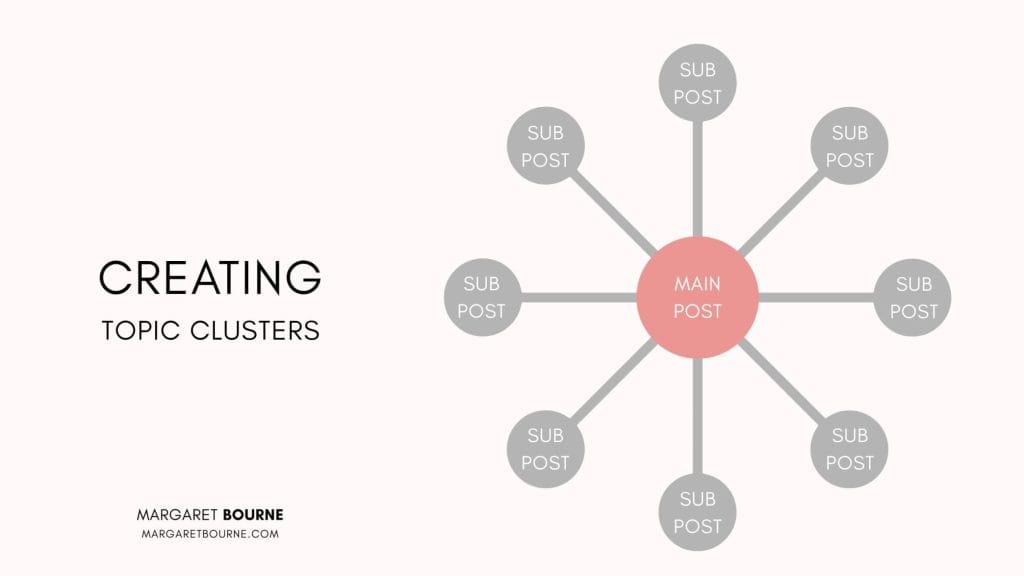
Here’s an example from one of my topic clusters:
- Main Post: How To Start A Food Blog
- Supporting Posts:
- How To Write A Food Blog Post
- How To Monetize Food Blog Posts
- How To Create Beautiful Food Photos For Your Blog
- Popular Food Blog Niches
- Food Hashtags For Social Media
- Food Quotes For Blog Content And Social Media
- Supporting Posts:
See how they can easily connect? This is often called the “Hub and Spoke” method of creating content clusters. It starts with one big core blog post, with supporting blog posts.
When you know how to do keyword research for blog posts that can be easily interlinked, it’s like adding fuel to a fire. You get better visibility than if you didn’t.
PRO TIP: You can have more than one topic cluster for each blog category.
RELATED: How To Create A Content Calendar For Your Blog For Organization And Consistent Posts
Commonly Asked Questions About Keyword Research
What are some of the most asked questions about SEO keyword research by bloggers? I’ve pulled together those that I’ve found in my Facebook group – The Blog It Better Society – and that I get from working with blog coaching clients.
1. Do I really need to do keyword research for my personal blog?
Keyword research will help your personal blog get found beyond an audience of your family and friends. It’s to your advantage to take the time to find the right keywords your target audience is using to search for content like yours. Write with intention!
2. How many keywords should I use in a blog post?
You will need one main focus keyword. Add a few related phrases or long-tail keywords (usually 2 to 5). Use them naturally throughout your post, including the headings and in the first paragraph. However, don’t stuff your keywords in your content. Keep it natural and human-sounding.
3. Which keywords are best to target – high volume or low competition?
New bloggers should focus on low-competition keywords as they are easier to rank for and give you quicker results. Focus on higher-volume keywords once your blog starts building authority and traffic.
4. How to know if a keyword is good?
Keywords are good if they are what your ideal reader is seeking online (search intent), have low-to-medium competition, and you can use it to confidently write a great, helpful post about it.
5. Do I need paid keyword research tools for the best success?
Nope! Some of the best free tools are Google itself (the autocomplete feature), Google Trends and Google Keyword Planner (via Google Ads). In addition to this, some of the premium tools have free options, such as LowFruits.io. Semrush gives you 10 keyword searches a day.
6. Can I use the same keyword in more than one post?
Doing this results in keyword cannibalization, where you have blog posts competing with each other in Google’s eyes. Always use one focus keyword per post or page.
7. Is keyword research only for Google?
No – when you learn the essentials of keyword research, it helps you with finding them in Pinterest, YouTube, Instagram, Facebook and more. Keywords help your readers discover you through searches. Almost all social media platforms are now considered search engines in their own right.
Keyword Research For Beginners: Final Tips
You now have the insights you need to know how to do keyword research for blog posts.
Let’s recap – here’s how to do keyword research:
- Understand your audience and what they’re seeking to find online for your topic, including search intent
- Brainstorm broad seed words
- Use keyword tools to find long-tail keywords
- From the longtail keyword list, choose high volume, low competition keywords
- Choose your main focus keyword
- Select secondary keywords that are related to boost your post’s visibility
Apart from knowing how to do keyword research for SEO, you also know where to add the keywords afterward.
You’re pretty much set!
If you’ve written and published many blog posts, your next step is to create a list of them all.
Start categorizing them into topic clusters. It will make it easier to interlink them and to do keyword research. You’ll find keywords that work for a number of your posts.
Update your blog posts for SEO and watch your blog traffic bump up over a period of time.
If you’re a new blogger, start writing blog posts that have strong keyword research done first. You’ll see your blog grow faster!
You’ve got this!
QUESTION: What questions do you still have on how to do keyword research for blog posts? Add them in the comments!
Love this post about keyword research for SEO? Share it with others on Pinterest – thanks!

Want more blogging advice from Margaret?
Add MargaretBourne.com as a Preferred Source so Google can highlight more of my blogging advice for you in Search, AI Overviews and AI Mode.